
By Dr. Raja Sankaran
18-June-2026
The Electric Acceleration: One in Four Cars Sold Globally Is Now an EV
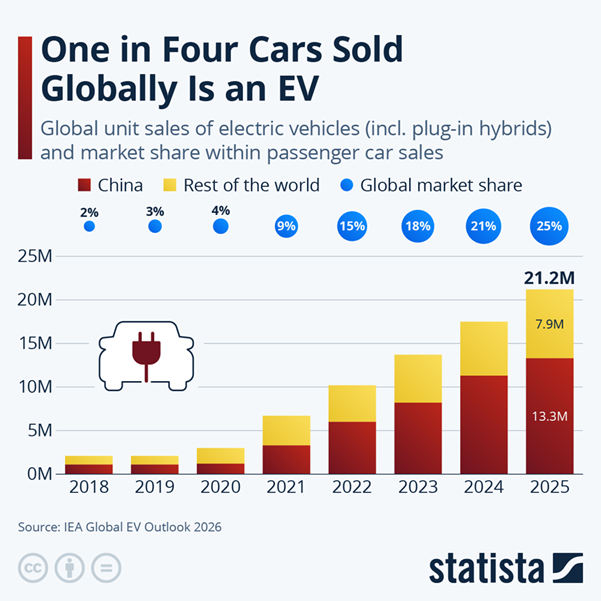
The automotive landscape is undergoing a massive shift. As shown in the data chart from image, electric vehicles (EVs), including plug-in hybrids, have officially crossed a monumental threshold: one in four passenger cars sold globally is now an EV.
What was considered a niche market just a few years ago has transformed into a dominant pillar of global transportation. Let’s break down the remarkable numbers driving this electric transition.
The Exponential Rise of EV Market Share
Looking back at the data from image, the growth trajectory of electric vehicles over the last seven years is staggering:
- 2018–2020: EVs held a minor sliver of the market, crawling from a 2% global market share in 2018 to just 4% in 2020.
- The Tipping Point (2021): The market more than doubled in a single year, jumping to 9%.
- The Surge (2022–2024): EV adoption surged aggressively, climbing to 15% in 2022, 18% in 2023, and hitting 21% in 2024.
- The New Milestone (2025): Electric vehicles captured a massive 25% of global passenger car sales, cementing their position as mainstream choices for consumers.
China Leading the Charge
A closer look at the breakdown in image reveals that global adoption isn’t entirely uniform. China remains the undisputed powerhouse of the EV revolution.
Out of the 21.2 million global EV units sold in 2025:
- China alone accounted for 13.3 million units—well over half of the entire global market.
- The Rest of the World combined made up the remaining 7.9 million units.
China’s aggressive manufacturing scaling, robust domestic supply chain, and expansive charging infrastructure continue to set the pace for the rest of the world.
Why the Momentum Isn’t Slowing Down
This rapid hockey-stick growth is being fueled by a perfect storm of industry evolution:
- Battery Innovation: Driven by a transition from older chemistries to high-density Lithium-ion and next-generation Solid-State concepts, batteries are delivering longer ranges and shorter charging times.
- Cost Parity: Scale of manufacturing is driving down retail costs, making EVs highly competitive with traditional internal combustion engine (ICE) vehicles.
- Expanded Options: Automakers are shifting entire lineups to electric, offering consumers everything from budget-friendly city cars to heavy-duty trucks.
With 25% of the market captured, the conversation has officially shifted from if electric vehicles will take over, to how fast.
Source: IEA Global EV Outlook 2026, via Statista.
Leave a Reply