
By Mohan Nagarajan
Introduction:
Ever since the first practical internal combustion engine was developed by Nikolus Otto in 1876 and later official working first prototype Automobile was built by Karl Benz in 1885, the automobile has been constantly going through phenomenal transformations over the last 140+ years.
These transformations are on account various innovations ranging from meeting the ever-demanding customer expectations from time to time, to meeting the ride and comfort, meeting the safety and comfort requirements and so on…
- As the vehicle population kept on increasing, the need to bring emissions under control and hence protecting our environment became paramount importance. Hence more and more stricter emission norms were introduced such as Euro2, Euro3…Euro6, Euro7 in the Europe and similarly BS1, BS2…BS6 in India.
- As the number would suggest, every time when the emission norms were made more stringent than before, more and more innovations came by the way new fuel injection systems such as single point throttle body injection, multi point injection etc. in Petrol and high-pressure common rail injection in diesel to improve the combustion quality and hence lowering the emissions on one hand.
- On the other hand, not just enough to meet the stricter emission only through the engine technology, technological innovations made leaps and bounds in the exhaust after treatment area by the way of treating the exhaust gases through Catalytic converters, Diesel Particulate filters, Nox storage catalyst, Selective catalytic reduction etc. before letting the gases to the atmosphere to meet the stringent emission norms.
As it happens with any other system, with ever demanding stringent emission normal, the science was stretched to its limit, that is when the infamous Volkswagen Diesel Scandal took place in 2016, which is an eye opener to the industry that an alternate source of power plant is required in the mobility area.
Stricter emissions targets in the European Union made it increasingly difficult to rely solely on combustion engines. This is where the Electric vehicle came under serious focus and major manufacturers around the world started to believe that electric vehicle could be an alternate source of mobility and major investments and innovations started to happen in the electric drive areas. The 2015–2016 diesel emissions scandal significantly accelerated the automotive industry’s shift toward electric vehicles, but EVs were already well known and had been under active development for many years before the scandal.
Electric vehicles:
- Energy source:
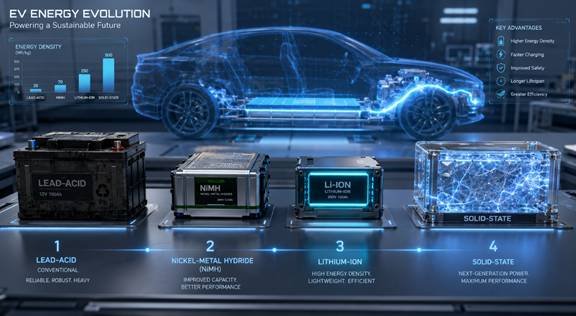
- The battery pack is the dominant energy storage component in an EV, and battery technology has become the single most important enabler for widespread EV adoption. Most innovations today aim at increasing energy density, reducing cost, improving charging speed, enhancing safety, extending lifetime, and reducing dependence on scarce materials. From the conventional Lead Acid battery that we know, we use in the combustion engine vehicle mainly for starting and lighting purposes to more improved Nickel Metel Hydride NiMH battery to Lithium Ion to now much more advanced Solid-state battery to increase energy density, reduce charging time and cost etc.
b. Electric Drives: Electrified passenger vehicles are commonly classified into four categories based on the degree of electrification and the method of charging the onboard battery system: Mild Hybrid Electric Vehicles (MHEV), Hybrid Electric Vehicles (HEV), Plug-in Hybrid Electric Vehicles (PHEV), and Battery Electric Vehicles (BEV).
- Mild Hybrid electric vehicle: In a Mild Hybrid Electric Vehicle (MHEV), the internal combustion engine (gasoline or diesel) remains the primary source of propulsion. The vehicle is equipped with a relatively small battery, typically 48 V, and an electric machine called an Integrated Starter Generator (ISG) or Belt Starter Generator (BSG). During braking or deceleration, the electric machine operates as a generator and recovers part of the vehicle’s kinetic energy (regenerative braking) to recharge the battery. The stored electrical energy is subsequently used to assist the internal combustion engine during acceleration (torque assist), restart the engine rapidly after stop-start events, power vehicle auxiliaries, propel the vehicle electrically for very short durations under limited operating conditions.
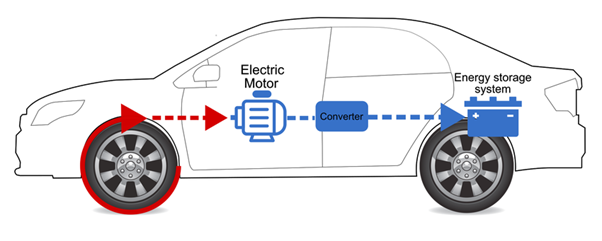
- Hybrid Electric Vehicle (HEV): In this case, both the internal combustion engine and the electric motor are capable of propelling the vehicle independently or together. The battery is considerably larger than that of an MHEV and is charged only internally through regenerative braking and / or excess power generated by the combustion engine. There is no external charging port. At low speeds and light loads, the vehicle can operate in pure electric mode for short distances. During acceleration, the engine and motor work together, while at higher speeds the combustion engine typically becomes the dominant propulsion source.
- Plug-in Hybrid Electric Vehicle (PHEV) is similar to an HEV but incorporates a much larger battery pack and an external charging interface. The battery can be charged by Plugging into the electrical grid, Regenerative braking, the combustion engine (in some operating modes). The vehicle is designed to operate primarily as an electric vehicle for daily commuting. Typical electric-only range is around 30–150 km. Once the battery state of charge becomes low, the combustion engine automatically starts and the vehicle behaves like a conventional hybrid.
A Battery Electric Vehicle (BEV) contains no combustion engine whatsoever. Propulsion is provided exclusively by one or more electric motors. The traction battery is charged only from external electrical sources. During deceleration, the electric motor acts as a generator and recovers kinetic energy through regenerative braking. Since there is no internal combustion engine, BEVs produce zero tailpipe emissions, have fewer moving parts, and generally exhibit higher drivetrain efficiency.

Leave a Reply