
The boom in Electric Vehicles (EVs) has revolutionized the way we think about transportation. But as millions of EVs hit the road, a critical question arises: What actually happens to the batteries powering this green revolution?
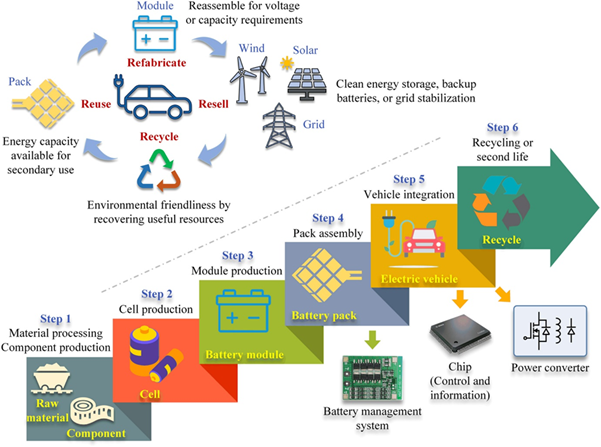
As shown in image, an EV battery doesn’t just stop working when it leaves a vehicle. It follows a highly structured 6-step lifecycle that spans from raw mining to a sustainable “second life” or recycling process.
Let’s dive into the fascinating, circular journey of an EV battery.
Part 1: The Manufacturing and Integration Pipeline (Steps 1 to 5)
Building a high-performance EV battery is a complex feat of engineering. The first half of the lifecycle focuses on taking raw earth elements and turning them into a clean energy powerhouse.
Step 1: Material Processing & Component Production
Every EV battery begins deep in the ground.
- Raw Materials: Essential elements like lithium, cobalt, nickel, and manganese are mined and heavily processed.
- Component Production: These materials are refined into core battery components like anodes, cathodes, and electrolytes.
Step 2: Cell Production
Once the components are ready, they are manufactured into individual battery cells. These are the fundamental building blocks of energy storage, resembling larger, highly advanced versions of everyday rechargeable batteries.
Step 3: Module Production
A single cell doesn’t pack enough punch to move a 2-ton vehicle. In this stage, multiple cells are bundled together into a tightly managed battery module to scale up the voltage and capacity.
Step 4: Pack Assembly
Modules are then combined to form the ultimate battery pack—the massive structure that sits on the floor of an electric car. This step also integrates vital sub-systems required for safety and efficiency:
- Battery Management System (BMS): The “brain” that monitors temperature, health, and charge levels.
- Chips & Controls: Microcontrollers that process information in real-time.
Step 5: Vehicle Integration
The completed battery pack is integrated directly into the electric vehicle chassis. Alongside power converters (which manage current flow between the battery and the motor), the battery is finally ready to power thousands of miles of zero-emission driving.
Part 2: The Circular Economy (Step 6 & The Secondary Loop)
What happens when an EV battery’s capacity drops to around 70-80% and it can no longer provide the driving range a vehicle requires? As the upper section of image_1b8669.jpg highlights, this is where the Circular Economy kicks into high gear through Step 6: Recycling or Second Life.
Instead of heading to a landfill, an EV battery enters a continuous loop of sustainability via three core paths:
1. Reuse (The Secondary Pack)
Even if a battery is tired of highway speeds, it still holds massive amounts of energy capacity. The intact battery pack can be reused for secondary, less demanding energy storage applications.
2. Refabricate & Resell (The Module Level)
If individual modules within the pack are still healthy, the battery can be disassembled. Engineers reassemble and refabricate these modules to meet specific voltage or capacity requirements. These refabricated units are then resold to support:
- Wind & Solar Energy Storage: Storing green energy when the sun isn’t shining or the wind isn’t blowing.
- Grid Stabilization: Helping power grids handle peak electricity demands.
- Backup Batteries: Providing emergency power for commercial buildings or homes.
3. Recycle (The Eco-Friendly Reset)
When a battery has completely exhausted its chemical lifespan, it undergoes a rigorous recycling process. This recovers the valuable raw resources (like lithium and cobalt) with high environmental friendliness, feeding them straight back into Step 1 to create the next generation of batteries.
💡 The Takeaway
The future of sustainable driving isn’t just about eliminating tailpipe emissions; it’s about closing the loop. By turning a linear “take-make-waste” pipeline into a circular ecosystem, the EV industry ensures that the clean energy transition stays clean from start to finish.
How do you feel about the future of battery recycling? Let us know your thoughts in the comments below, or share this infographic to spread the word about sustainable tech!
Reference
Liu, W., Placke, T., & Chau, K. T. (2022). Overview of batteries and battery management for electric vehicles. Energy Reports, 8, 4058-4084. https://doi.org/10.1016/j.egyr.2022.03.016
Leave a Reply